Showing posts with label Alpine Flowers. Show all posts

Thursday, 10 March 2016

Wildlife of Spain’s Sierra Nevada


Wildlife of Spain’s Sierra Nevada

Spain’s Sierra Nevada region is unique in that its altitude spans a massive height difference from about 700m above sea level to the Lofty Mulhacen at 3482m. This give it several distinct climatic zones with a huge degree of biodiversity coupled with over 100 endemic species including 63 endemic species of plant. It is situated about 50 miles east of Malaga on the south coast of Spain and just to the south east of the city of Granada and a day out in the Sierra Nevada mountains makes a great option if you are visiting Granada.

Satellite image of The Sierra Nevada showing proximity to the sea. The area in white is snow covered mountains.
The Sierra Nevada was first recognised in 1986 when it was awarded the status of being a UNESCO Biosphere Reserve.  In 1989 it was awarded “Natural Park” status and in 1998 the central area was awarded National Park status becoming Spain’s 11th National Park. 

In terms of size, The Sierra Nevada National Park is Spain’s largest with some 330 square miles. It is surrounded by the Sierra Nevada Natural Park of some 340 square miles, so together they are a massive 670 square miles.

The Sierra Nevada, National Park in green, Natural Park in Blue

The land inside the National Park enjoys a higher level of protection. Additionally, people live within the Natural Park (similar to U.K. National Parks), whereas there are no permanent human settlements in the National Park, only summer farms. The Padul Ponds at the western end of the range are significant wetlands and being in the Natural Park also enjoy a higher level of protection.

To describe the Sierra Nevada we generally divide it into “climatic zones” which have their own characteristics in terms of wildlife though some species (Iberian Ibex, eagles, vultures, etc.) transcend all zones. The only zone that we describe that is not climatic in the same sense is the limestone area of the western edge of the Sierra Nevada which due to its geology has it’s own unique flora.


Mediterranean
Altitude typically below 800m
Terraces of citrus, olives and small holdings.

Wild flowers on the hillside in spring


Purple salsify, Tragopogon porrifolius 
Birds: Crag Martins, Bee Eaters

Animals: Iberien Ibex, common Genet.

Plants: Herbs!

Spring arrives early here, when we can enjoy the terraces of almond, which flowers from February, and citrus where the air can be scented with orange blossom in March and April. Migratory birds are passing through or arriving to nest from March. Wildlife walks at this height are at their best from March through to May.


Fields of wild flowers


High Villages and Farms (e.g. Alpujarra)
Altitude typically 700m to 1600m.
Terraces of Olives, Almonds, Wallnuts, Chestnuts, cherries. Small holdings with Sheep and goats.


Typical Alpujarran landscape, early spring.


Swallowtail, Papilio machaon
Birds: Hoopoes, Bee Eaters, Booted and Golden Eagles.

Animals: Wild Boar, Iberian Ibex.

Plants: Various Orchids, Iris, Rosey Garlic. 

Herbs, Jerusalem sage

Spring starts with the almond blossom, often in February. However it is still a little early to enjoy much else and the weather is still cool. By the end of March the orchids are starting to flower and all through April and May the flowers are stunning and the migratory birds are arriving back.  By June it is getting hot at this level so we now turn our attentions to higher altitudes.

Shepherds walking with their flocks of sheep and goats are a common sight


Pastures of pink fringed orchids, April
White asphodels, March to May


Low Alpine and Summer Farms (Transhumance)
Altitude typically 1600m to 2300m.
Chestnuts and Wallnuts, summer farms.

Resting beside an acequia

The Sierra Nevada Blue  - Polymaths golgus
Birds: Choughs, Ring Ouzel, Eagles and Vultures.

Animals: Wild Boar, Iberian Ibex. Polyommatus golgus butterfly

Plants: St Bruno’s Lilley, Verbascum nevadense, Pyrenean Oak, Holm Oak.

Although it is possible to explore this area in April or May, it is really in June and July that the area is at its best with lovely meadows and flowers, bubbling streams and examples of summer farming (transhumance) still being practised.


Verbascum nevadense an endemic mullien

St Bruno's Lilly - Paradisea liliastrum


Cows returning after a summer in the high pastures


Mid Alpine and Summer Grazing
Altitude typically  2300 to 3000m
Cows grazing “wild” during the summer. Sheep and goats led here daily in summer.

Spring flowers (mid June) in the mid alpine zone, here an abundance of Broom!


Broom - Cytisus galianoi
Birds: Wheatear, Eagles, Vultures

Animals: Iberian Ibex, Beetles, Parnassius apolo butterfly

Plants: Junipers, Brooms, Gentians, Snow Star, Senecio boissieri


To experience the mountainside coloured yellow as the brooms are in flower is a remarkable sight! Herbs in flower with the Broom provides a great setting for butterflys, especially the white Parnassius and the Sierra Nevada Blue. In the wetter areas we are treated to a festival of flowers, gentians and the emblematic Star of the Snows. Mid June and through July are the best months.


The White Apollo butterfly, Parnassius apolo feeding on Thyme


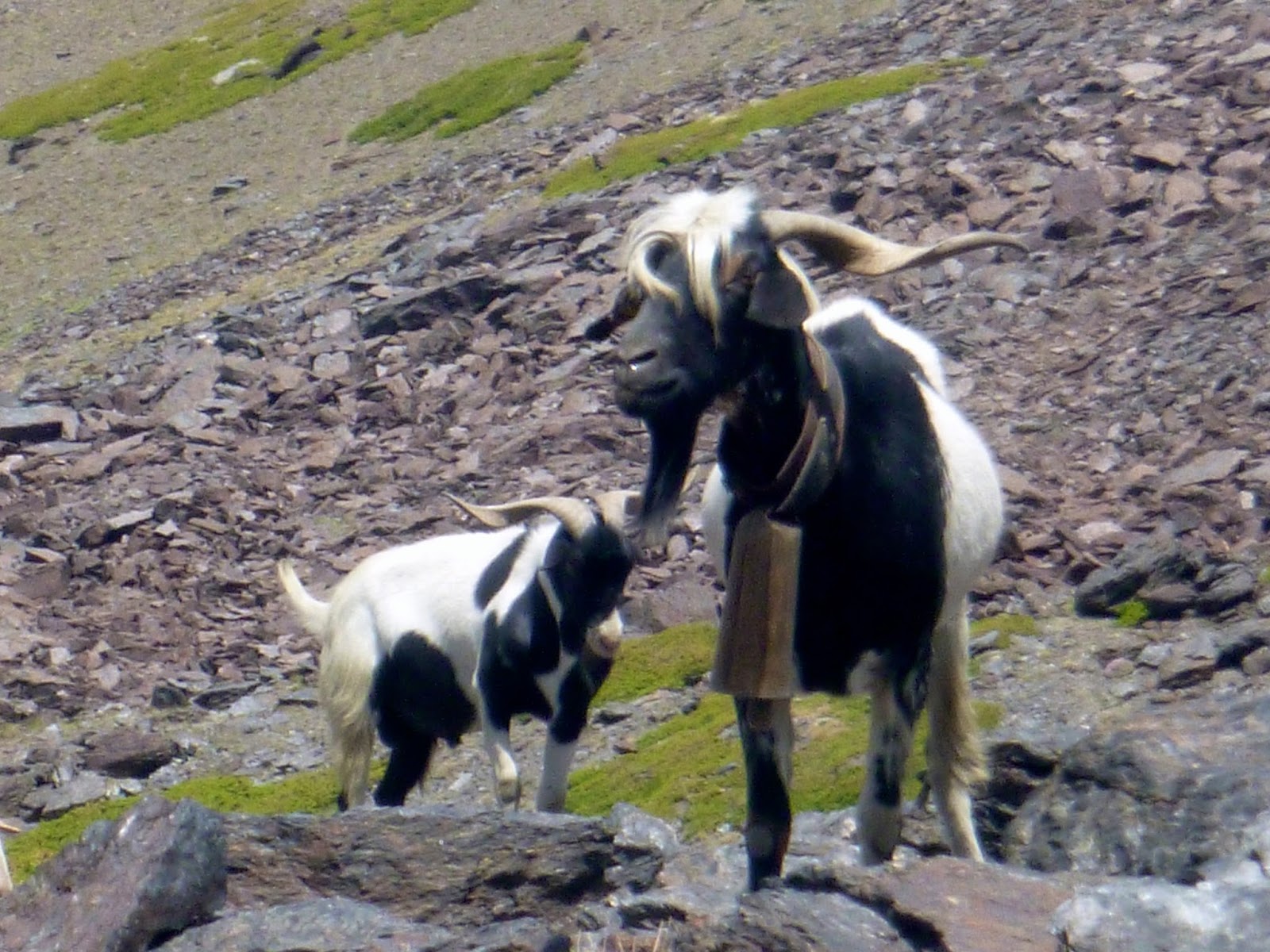
Goats grazing amongst the rocks
Senecio Boissieri, endemic to the Sierra Nevada and Sierra de Gador


High Alpine
Altitude typically above 2900m – “Siliceous High Alpine Grassland”
Fortunately the National Park "Interpretation" Service provides busses to 2700m on the south side of the range and to 3000m on the north side making this area relatively accessible.

Viewpoint near the bus drop off at 3000m on the north side of the Sierra Nevada


Iberian Ibex, Capra pyrenaica, a common sight.
Birds: Alpine Accentor, Alpine Swift, Golden Eagle, Vultures

Animals: Iberian Ibex, Butterflys

Plants: 
Vegetation is scarce, often rare and unique, 
Tyme, 
Artemisia_granatensis,
Viola crassiuscula,
Chaenorrhinum glareosum,
Erigeron frigidus,
Leontodon boryi,
Papaver lapeyrousianum, etc.


The Sierra Nevada Camomile, Artemisia granatensis

This is a magical zone of many endemic and rare plant species, where swifts and swallows soar and dance in the air, where eagles and vultures ride thermals and “Cabra” – Iberial Ibex frequent close to humans hoping to pick up left over sandwiches! When to come very much depends on how much snow there has been. It’s sually o.k. from mid June and most flowers can be seen through until the end of July.


The endemic Sierra Nevada Violet,
Viola crassiuscula
Alpine Accentor - Prunella collaris 


Erigeron frigidus - Cold Fleabane, a rare  endemic plant growing at over 3000m, it is thought only 130 specimens remain.


Borreguiles - High Altitude wetland areas
Altitudes typically between 2600m and 3100m
Famous especially for plants: Veronica nevadensis, Gentiana sierrae, Estrella de las Nieves, Lotus glareosus, Thin Spurred Butterwort – Pinguicula nevadensis.

The "magnificent" Siete Lagunas, largest of all Borreguiles

Near Pico del Caballo
These are protected wetland areas within the National Park found at heights of between 2600m and 3100m. They may be pools, streams or ribbons of dampness, but they are a distinct habitat with numerous endemic species of plant. Because of altitude differences and aspect, these may be snow free from as early as mid April or mid July. Due to the relative low altitude (!) these areas are often in the range of grazing animals (Sheep, goats and cows), so whereas one day there may be a fine display of flowers (gentians), come back a day later and they are gone! May, June and until mid July are good times to plan a visit to these (depending on altitude and aspect).


Lotus glareosus, gravel birdsfoot with gentians and snow stars


The emblematic Star of The Snows, Plantago navalis


The endemic Gentian, Gentiana sierrae


Limestone of the Western Edge
The limestone extends from lower altitudes (Niguelas 950m, Monachil 700m) to the impressive summit of Trevenque 2080m.


The path to Trevenque showing a limestone desert!


Echium albicans (Boragináceas)
Plants: Lavenders, Rosemary, Echium albicans, Convolvulus boissieri, Paeonia coriacea, Junipers 
Brooms, Holm Oak, rock rose


This area is dominated by the impressive Trevenque 2080m, sometimes described as the Matterhorn of the Sierras. A walk to or around Trevenque rarely disappoints between mid April and June. You will almost certainly see Ibex on Trevenque, but it is the plants that are different here to the rest of the Sierra Nevada.


Paeonia coriacea 
Convolvulus Boissieri


Heath Fritillary - Melitaea athalia

Michael Hunt and Jane Livingstone are both International Mountain Leaders based at their Mountain House at 1300m above Lanjaron. IML’s are trained and assessed in environmental issues and environmental interpretation in addition to mountain guiding. Their walking holidays – “Mountain Walking Holidays” offer Wildlife of the Sierra Nevada Walking Holidays or alternatively if you are in the area, and want a day trip to explore some of the wildlife, this can be arranged through Sierra Nevada Guides.


Michael and Jane have been exploring the Sierra Nevada since 2003.


Monday, 17 November 2014

Walking in Slovenia’s Julian Alps


Walking in Slovenia’s Julian Alps

We first discovered Slovenia’s Julian Alps on a weeks Spring break in May / June 2011.  Since then we have spent a further 5 weeks getting to know the area in some depth.


Lake Bohinj
The Julian Alps are believed to be named after Julius Caesar and are the highest mountains in Slovenia with at Triglav 2864m the highest summit. The Slovene people are rightly proud of their mountaineering heritage and the national flag has Triglav represented on it. There is a “saying” in Slovenia that you are only a true Slovene if you have climbed Triglav.

As an alpine nation, its mountains are not as high as those in neighbouring countries but they are equally spectacular. There is an extensive network of mountain huts throughout its mountains making it quite possible to stay for longer periods high up without having to keep descending to a valley base each evening.


Martagon Lilly
Our first trip was in the spring of 2011.  Too early to access the high paths and summits because the high mountains were full of snow. We were able to walk to the summer pastures on the low alps where the cows were being taken up to from the villages and the wild spring flowers were very impressive. We were surprised at the warm weather, though the proximity to the Mediterranean generally gives a warmer and more stable climate than the western alps.

The second trip we made was for two weeks in August 2011.  The paths and mountains were now mostly clear of snow and we were able to explore the extensive network of paths and huts in the high mountains. Especially memorable was seeing both Edelweiss and the rare, endemic, Zoiss Bellflower.

We returned again for two weeks in 2013, this time leading walking holidays for Mountain House Holidays. We led two, week long holidays and were able to take our clients to the summit of Triglav. We became true Slovenes!

In September, 2014 we had the privilege to return once more leading a hut to hut walking holiday for Mountain House Holidays. Memorable on this trip was the accordion playing that we experienced at all of the huts we stayed at.


Pogacnikov Dom


Zoiss Bellflower
Situated less than an hours drive from Ljubiana Airport, the Julian Alps are very accessible. There are flights from both London Stanstead and Luton airports. We have found car hire quite cheap though there are taxi’s and mini-bus taxi’s available. By booking them in advance these also work out quite cheaply.

If you are planning to visit in springtime, there are lots of flowers out in late May and early June. An ideal base would be around Lake Bohinj. There are plenty of hotels, guest houses and hostels here to suit all. Hostel 13 in Studor offers good clean basic self catering accommodation. Hotel Starre offers good hotel accommodation.


Edleweiss
For summer hut to hut trips you need a start and end point. The Aljazev Dom at the head of the valley above the village of Mojstrana has a massive “wow” factor that it overlooks the mighty north face of Triglav. This is one of the few huts that has showers and you can get a taxi or drive to within about 400m of the hut. We have also left bags here with our clean travelling clothes to return to on several occasions.


If you want a guided itinerary, Mountain House Holidays will help you sort out a suitable itinerary and provide you with a qualified International Mountain Leader who has knowledge of these beautiful mountains.


Mike and Jane from Mountain House Holidays are always willing to advise you to plan your walking holiday in Slovenia.

Chamois


Thursday, 18 July 2013

Mulhacen, Magnificent!


Mulhacen, Magnificent!

It’s normal for us at Mountain House Holidays to be guiding people up Mulhacen which at 3482m is the highest mountain in The Sierra Nevada and the whole of mainland Spain. However yesterday, having a day off we decided to climb Mulhacen ourselves for the sheer enjoyment of it. Legend has it that Mully Hasan the deposed and penultimate Arab King of Al Andalus is buried on the mountain.


Mulhacen Summit
Most people tackling Mulhacen take the National Park bus from Capileira up to Alto del Chorrillo at 2700m and ascend and descend Mulhacen’s South Ridge. It’s fine to use the bus and the South Ridge as part of the excursion but to only do a “there and back from the bus” is a short day and will leave you thinking it’s not been a proper day out!


Setting out early in summer is the best tactic. This allows you to get the climbing done before the heat of the day starts to sap your energy. We started from Hoya del Portillo 2160m at 7.30am. It was cold, 10 degrees C and for the first 20 minutes we were in the forest so no sun. Still the motto is: start cold and warm up walking up hill! By the time we had reached the view point of Puerto Molino 2380m (30 minutes) we were warm! Our route continued along the ridge of Prado Llano 2577m to 2622m before joining the old road along to Alto del Chorrillo arriving there for a breakfast break at 9.15am.


Dense Flowering Sandwort
The actual ascent of Mulhacen along the south ridge is pleasant, and in summer a well defined path with cairns marking the way through the screes just below the subsidiary summit of Mulhacen II at 3361m. Even though we stopped to take photo’s of plants and beetles, we reached the summit at 11.20am a total time of 3 hours and 50 minutes. A distance of 11.4Km with a total height gained of 1412m. An hour and 20 minutes ahead of Naismith (The rule for calculating the time to walk up mountains – allow 4Km per hour and add a minute for every 10m of ascent).


We were ahead of the crowd from the bus so the summit was fairly quiet. There was a small group of “Cabra” the Iberian Ibex mooching around not particularly afraid of us, the usual Alpine Accentor and a large squadron of Swifts giving a good display of aerobatics.


Iberian Ibex
After a short break on the summit, it was time to head downwards before the crowds from the bus arrived. There is a zig zag path down the screes of Mulhacen’s West flank which we took heading to the Collado de la Mosca which gives great views of both Mulhacen’s and Alcazaba’s 3371m North Faces. A further 10 minutes and you are down to the Caldera Hut, an unmanned “bivouac” hut with bunks, tables and chairs. From here there is an impressive view back up to Mulhacen’s summit. A spot of lunch was called for at The Caldera!


With clients if we had caught the bus we would continue down to the Poqueira Refuge 2500m to make a circuit back to Hoya del Portillo. However as we had not walked the old road back to Alto del Chorrillo for a few years we though we’d re-acquaint ourselves with this option. It proved as boring as we remembered it though a useful way out if the weather turns nasty. From Alto del Chorrillo we then returned the way we had ascended finally arriving back to Hoya del Portillo at 3.30pm.

Mulhacen's West Flank from the Caldera Refuge

All that remained was to drive back to a bar in Capileira for the customary drink and plan for the next outing!


The Sierra Nevada Guides website has a lot of useful information for people wanting to visit the area, especially for walkers and climbers.

We are always happy to respond to emails answering questions about the area.

Monday, 15 July 2013

It’s cool in the mountains! Summer arrives in The Sierra Nevada


It’s cool in the mountains! Summer arrives in The Sierra Nevada

Although summer has been a few weeks late in arriving this year, it has now arrived and is firmly established. Although our Mountain House is at 1300m above sea level, a few days ago I found it hard to sleep as the bedroom was airless and it was too hot to be comfortable inside at 21 degrees C.  As a consequence I got up early and decided to check out the conditions on Veleta 3394m the second highest in Spain’s Sierra Nevada.


The Carrihuela Refuge from Veleta
Leaving home at 6am where it was 21 degrees I drove to Hoya de la Mora (2500m) where it was a cool 13 degrees and felt distinctly cooler with a brisk wind blowing. The ascent of Veleta is one of the easiest of all the mountains in the Sierra Nevada. A gentle ridge and fairly good path for all but the final 200m of ascent where there is a steep zig zag path up through scree and boulders. Reaching Posiciones del Veleta at 3100m a Griffon Vulture soared overhead reminding me that I always see them when on Veleta. By the time I got the camera out and switched on it was too far to make a decent picture.  


Griffon Vulture
In total it took me two hours to reach the summit and although there was snow around, I didn’t have to cross any patches on my ascent. For most of the climb I was just about warm enough in shorts and a t shirt though my hands started to get cold near the summit. Once on the summit and no longer generating heat from the exertion of ascending I needed a windproof fleece hat and gloves. I guess it was around 5 degrees with the windchill. Cool!


"Blue Dreams"
I choose to descend towards the Carrihuela refuge 3205m down by the old track that used to cross the Sierra Nevada from Granada to Capileira on the south side of the range. As usual for this time of year the track was buried in snow for about 1Km beyond the refuge. On the way to the refuge there were a number of alpine plants coming into flower as the snow had recently receded. And I managed to get a few photo’s before the battery in my camera gave up! Notable were the Sierra Nevada Violet (Viola crassiuscula) and “Blue Dreams” (Chaenorrhinum glareosum). It was at this point with the camera out of action that I noticed a group of six Grifon Vultures circling above me!


The Sierra Nevada Violet
At the Carrihuela refuge I met a cyclist who had wanted to take the old road and cross the snow with his bike heading for Capileira.  The snow was still frozen hard and the slope to cross is very steep with a bad run off if you were to slip. Fortunately he had already decided against it though it would be a massive 120Km detour. He said he’d cycled the route a few years ago and I left him considering whether or not to wait until late afternoon when the snow might be safe enough for safe passage without crampons.


Mulhacen from The Carrihuela Refuge

The rest of the descent back to Hoya de la Mora was a pleasant stroll though I could feel it warming up! Soon the gloves came off, the fleece hat was replaced by a buff and eventually the windproof came off too. It was a pleasant 22 degrees back at the car and I headed to the “University Albergue” for a cool beer and tappa.

Veleta from the comfort of Hoya da la Mora
Mountain House Holidays run guided walking holidays in Spain's Sierra Nevada Mountains. Mike and Jane the owners of Mountain House Holidays are both qualified International Mountain Leaders.

They also run Sierra Nevada Guides and undertake guided walks for individuals and groups. There is a lot of useful information for people wanting to visit the Sierra Nevada on the Sierra Nevada Guides website.