Showing posts with label Capileira. Show all posts

Thursday, 20 November 2014

Walking in The Alpujarra


Walking in The Alpujarra

The Alpujarra is the area that is the southern slopes of Spain’s Sierra Nevada mountains. Having walked all over Europe and in North Africa, I can honestly say that the walking here is unsurpassed. This is hill walking terrain rather than mountain walking of the high Sierra Nevada. It is characterized by steep sided valleys, terraces and pretty white washed villages.

Walking in The TaHa
 Although many of these pretty white washed villages provide a good base to stay, Capileira is undoubtedly the best place to base yourself. There are several good day walks to be had straight from the village and other walks could be had by either driving out or by catching the bus.

Busquistar, a village in The TaHa
Sierra Nevada Guides have some walks already written up on their website and run a programme of guided walks in the spring (April, May and early June). If you are thinking of a walking holiday for your walking club, then Mountain House Holidays are able to organize a package for you. A full board, fully guided week from £695.

It’s hard to pick out a favorite walk as there are so many to choose from, and according to season when flowers are out. Undoubtedly walking in the Rio Poqueira from Capileira or in the Taha de Pitres provide the best walking. It is also possible to venture up into the Sierra Nevada without having to tackle the mountains. Hoya del Portillo above Capileira provides a good starting point. Only half an hour above Hoya brings us to the viewpoint of Puerto Molino where the higher summits can clearly be seen, especially Mulhacen (the highest mountain in mainland Spain) and Veleta the 2nd highest in the Sierra Nevada.

Walking in the Alpujarra can get too hot in July and August.  Good times are March to June and September to November.  That said, if the sun is out, it is possible to walk in T shirts throughout the winter!

T Shirts in winter!

Capileira
If you are restricted to the height of summer, there are several walks to be had in the high mountains where it is cool at altitude. It is possible to catch the National Park bus from Capileira to Mirador Trevelez 2700m asl. You can expect the tempreture at 3000m to be around 15 to 20 degrees during the afternoon in July if it is not windy. With wind chill you might be looking to wear a fleece or jacket.
From Mirador Trevelez, the old road leads to The Caldera at just over 3000m. From here a path leads down the Rio Mulhacen and you can make a circuit via the Refugio Poqueira (food, drinks and toilets) before returning to the bus at Mirador Trevelez.

Maps and English guidebooks are available locally, but to help with your planning, they can be obtained in advance from Stanfords. The Editorial Alpina map / guide to the Sierra Nevada and Alpujarra is a good start. Spanish maps are usually flimsy so consider getting your map laminated before you go.

Accommodation is plentiful. Pensions, Hotels and self catering are all available. If you are planning to visit in the hotter months (mid June through until the end of September, look for somewhere with a pool or plunge pool.  It’s great to cool off after a good walk!


Mountain House Holidays and Sierra Nevada Guides are the only qualified British guides (International Mountain Leaders) based in the Alpujarra / Sierra Nevada.




Tuesday, 4 December 2012

Walking in the Warm! - Spain


Walking in the Warm!
Walking in the warm has become a dream as the British winter is now taking hold. A wet summer followed by a wet autumn, now a wet cold winter has left me dreaming of some warmth and the chance to walk in some sunshine.

Walking holidays don’t need to be expensive, especially if southern Spain is your destination.  There are cheap flights from all U.K. airports to Malaga which can be the gateway to a wonderful walking holiday in AndalucĂ­a’s Alpujarra region. The Alpujarra is the area nestling into the southern slopes of Spain’s Sierra Nevada Mountains. The area has been mainly influenced by the Berber Arabs who colonised this area from the 8th Century and is characterised by pretty white villages linked by a network of paths, mule tracks and watercourses known as Acequia’s.

February warmth in The Alpujarra


Mountain House Holidays (operating from their mountain house high in the Alpujarra) have a vast local knowledge of the walking in the area and their walks are led by qualified International Mountain Leaders. There are walking holidays scheduled for February, April and May.

Walking in T shirts is not uncommon in winer!
The walking in the Alpujarra is classic hill walking so don’t expect flat easy paths, but is well within the capabilities of those used to walking at a basic level in British hills (South Downs, Peak District, etc.). 
A flavour of the area can be gleaned from Chris Stewarts superb book, “Driving over Lemons.”


Favourite walks included in the Itineraries usually include:

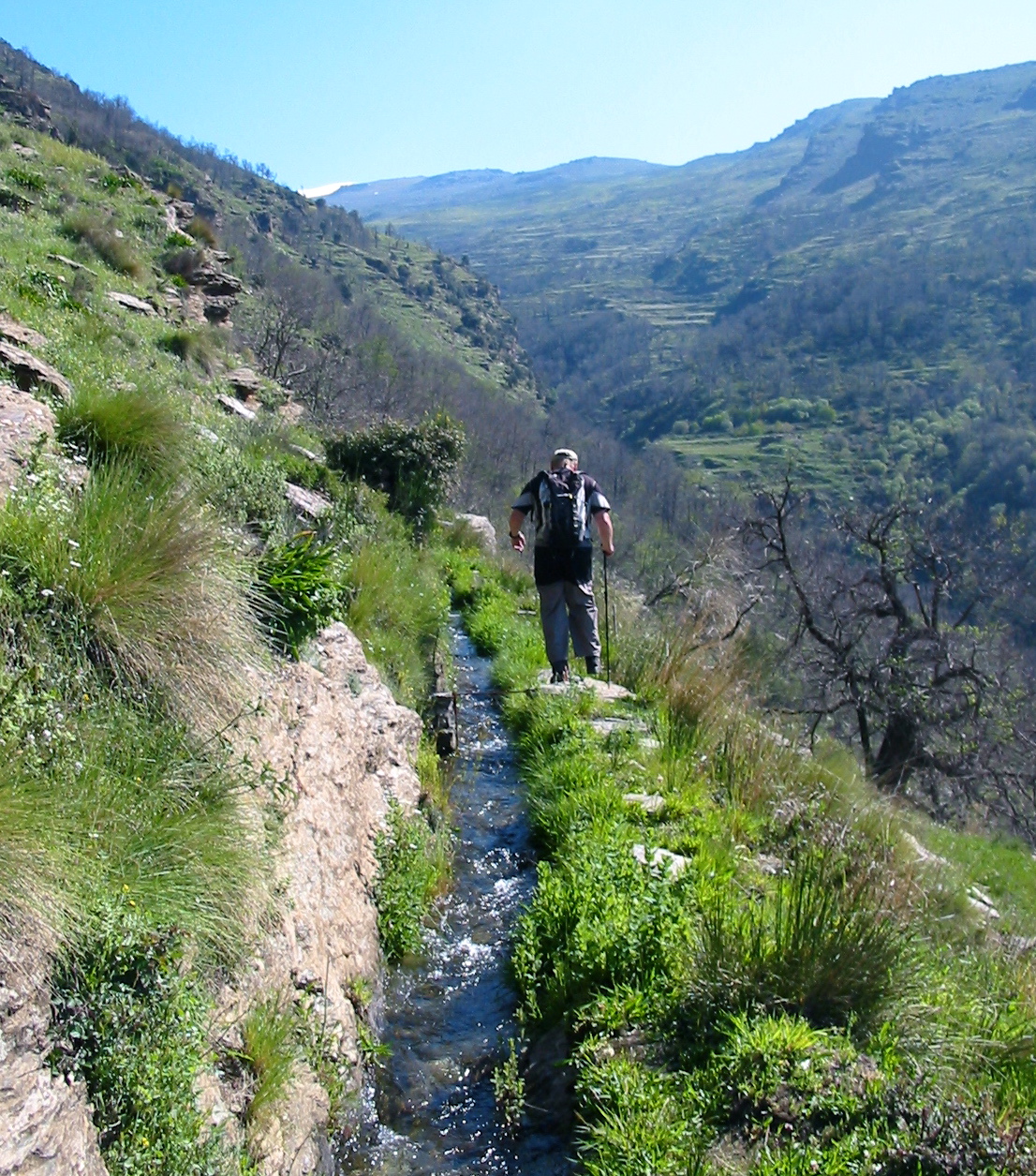
Walking beside an Acequia near Lanjaron
A circuit in the Poqueira Gorge, which takes in the delights of the prettiest three villages, Capileira, Bubion and Pampaneira. The walking here is a mixture of walking through ancient terraces as we ascend the valley before taking in the delights of the “whitewashed” villages with their narrow streets, public Lavado’s where old ladies can still be seen doing their washing and of course the odd bar!

A circuit in the Taha, a name given to the valley beneath Trevelez which is Spain’s highest village, famous for its dry cured ham. The walking here takes a line on an old mule track through improbable cliffs, past goat farms, ancient bridges, terraces and white washed villages.

A circuit above the spa town of Lanjaron. This walk follows ancient mule tracks through terraces, follows acequia’s and gives superb views down to the coast and on clear days across to the mountains of North Africa. 
Lanjaron is famous for it’s spa water and as a “resort” has many craft shops, and a range of bars and restaurants.

Alpujarran Street scene
Mountain House Holidays offer you a complete package, starting from when we meet you at Malaga Airport through until when we drop you back at the airport at the end of your holiday. You just arrange your flight and insurance, we organise your travel in Spain, your full board accommodation and a week of fully guided walking led by qualified walk leaders with a full local knowledge of the area.

For those who prefer “self guided” holidays, we are able to organise accommodation and provide written details of the walks we lead.

Thursday, 8 November 2012

Walking in Spain's Alpujarra and Sierra Nevada


Walking in Spain’s Sierra Nevada and Alpujarra

For the past ten years since we bought our mountain ”cortio” in Spain’s Sierra NevadaMountains and Alpujarra, we have enjoyed exploring the hills and mountains just south of Granada.  Since 2004 we have been organising walking holidays here as Mountain House Holidays though we also operate a guiding service as Sierra Nevada Guides and are the only qualified British International Mountain Leaders operating in the Alpujarra and Sierra Nevada Mountains.

Mulhacen
The Sierra Nevada boasts mainland Spain’s highest mountain, Mulhacen at 3482m.  The southern slopes of the Sierra Nevada are known as the Alpujarra an area great for hill walking, especially in the winter months when the high mountains are covered in snow.

Walking is possible in the Alpujarra all year round though from mid June until the end of August it is too hot for most people. However when the sun is out even in mid winter we have been stripped down to T shirts. 


Alpujarra Street
This part of Spain was ruled for centuries by Muslim kings and was colonised by Berbers from the Atlas mountains of Morocco.  The architecture of the villages is identical to those of the Atlas mountains.  However the tradition here is to paint the houses white and the villages look stunning adorning the hillsides, prettiest of all being Pampaneira, Bubion and Capileira.

The Sierra Nevada has been described as like Cairngorm with altitude! Unless you enjoy winter mountaineering or snowshoeing, the high mountains of the Sierra Nevada are best avoided in the winter months and spring. The high mountains start to become accessible again from mid June and remain so most years into November.

Gentians and "The Star of The Snows"
The area is a national park and is famous for it’s wildlife. There are many endemic species in addition to those shared with other areas. This is because of the huge variation in altitude with climatic zones from Mediterranean to Alpine. Here it is almost certain that if you know where to go you will see eagles and vultures circling above you.

The walking can be varied too, encountering terraces of almond blossom, chestnut woodland and oak forests. There is even an extensive forest of Scots Pine!  In the high mountains as the snow retreats in summer the ground becomes carpeted with Gentians and a local version of the Edelweiss known as the Star of the Snows.

The pretty white villages all have water fountains to replenish drinking bottles and there are many wayside “fuente” too, some famous for their mineral waters and even fizzy.

Enjoying the December Sunshine
February, March, April and May are nice times to visit the Alpujarra as the land is green with new plant growth.  Easter in this area brings traditional processions of statues from the local churches through the narrow streets thronged with crowds.

Summer though hot in the valley, is a great time to walk the higher peaks of The Sierra Nevada. Sun is almost guaranteed in the summer and we have never had to wear a waterproof jacket though occasionally a windproof.  Up high the temperature will be between 15 and 20 degrees during the summer though can drop considerably in high winds.

"Cabra de Monte" Iberian Ibex
Autumn is a good time for both the Alpujarra and Sierra Nevada.  The tourists disappear, everywhere becomes quieter though the warm weather stays. The weather does become changeable but not to the extent that it rules out walking.

Footpaths are not well marked though the maps available are adequate and there are several guidebooks detailing the walking that can be bought in the U.K.


Our walking holidays take advantage of our local knowledge of the best walks ensuring that no day is wasted. For those organising their own holidays, there are a selection of our favourite walks available to download from our Sierra Nevada Guides website.